user experience research to guide decisionmaking
Case Study 1: Evaluating User Acceptability and Adherence to Inform the Product Roadmap for a Novel HIV Prevention Product
Project Overview
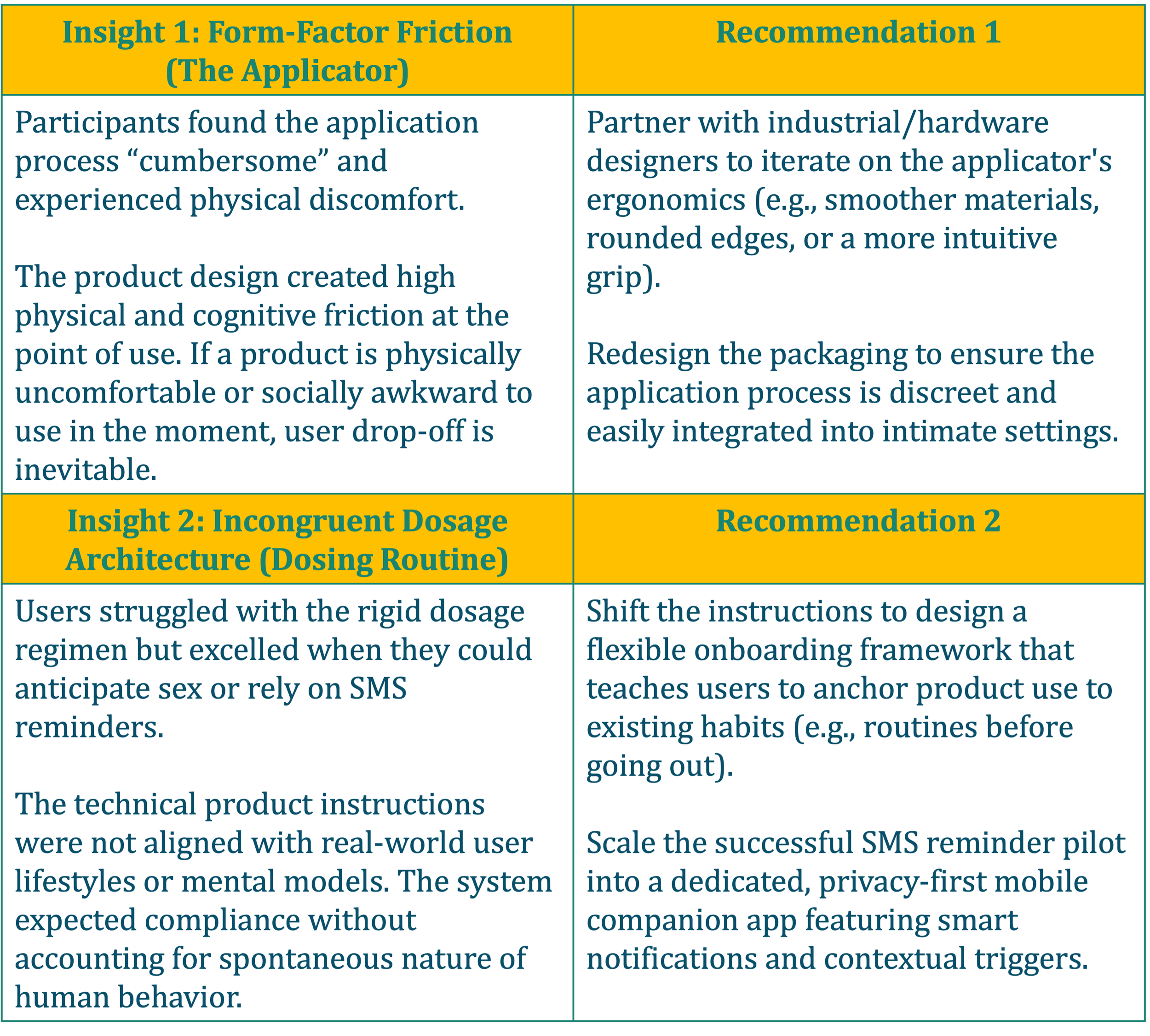
In clinical product development, user acceptability and adherence are the ultimate measures of product success. I led a mixed-methods research study evaluating a novel HIV prevention product. By analyzing real-world usage behaviors, I identified critical usability flaws in the physical device and mismatches in the dosage scheduling. My insights provided actionable recommendations to redesign the product form-factor and pivot the usage instructions strategy to improve long-term user adherence.
My role: Project Director
Timeline: 12 months
Challenge: How can we identify human behavioral friction points to optimize the physical design and usage instructions of a novel HIV prevention product before clinical mass production?
Methods
Quantitative Behavioral Surveys: used to validate qualitative themes at scale and quantify which usability barriers were most prevalent across a larger user cohort
Digital Diary Study: used to capture contextual, real-time user behavior and longitudinal habits in the user’s natural environment, minimizing recall bias
Evaluative User Interviews: used to dive into the “why” behind diary data and quantitative product acceptability ratings and to uncover specific usability flaws, social stigma barriers, and cognitive friction
Product Features Evaluated:
Applicator: Size, wrapper, assembly process, insertion process, comfort, portability
Gel: Viscosity, volume, ease of use
Acceptability: liking product during trial and likelihood of future use
Dosage: comparison of daily versus context-dependent dosing schedules
Case Study 2: Evaluating Data Privacy and User Friction in an International Digital Health Tracking System
Project Overview
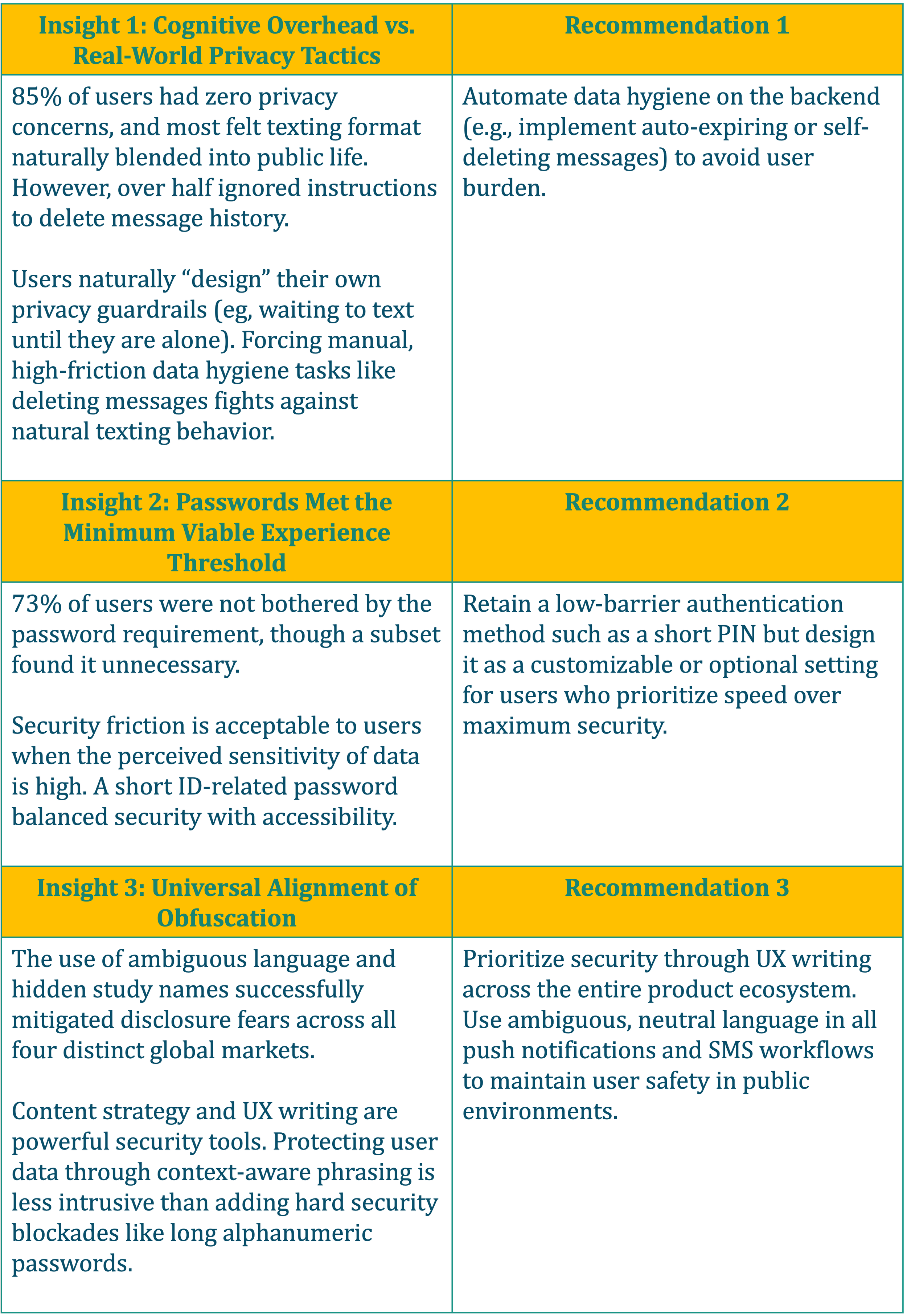
A mixed-methods study across four countries analyzed how data privacy features impact user friction in a global digital health tracking system, revealing that content-masking provides high security with low friction, while manual security tasks fail to gain compliance. The research, covering 187 participants, established actionable design principles balancing data protection with seamless user experience.
My role: Lead Mixed Methods UX Researcher
Timeline: 14 months
Scope: Multi-market research across 4 countries (Peru, South Africa, Thailand, United States)
Challenge: When tracking highly sensitive medical behaviors via digital SMS channels, protecting user data privacy is paramount to prevent accidental disclosure and social stigma. However, implementing heavy security protocols often introduces immense user experience friction, threatening daily compliance.
Methods
Quantitative Online Self-administered Surveys: administered to 187 global users to measure the statistical burden of the security features and quantify privacy concerns.
Qualitative Interviews: conducted with a subset of 33 users to deep-dive into real-world behavior, contextual usage patterns and why certain security protocols succeeded or failed.
System Features Evaluated:
Availability checks: System confirmed user was available before sending data questions
Authentication: Required a password/short ID to reply
Ambiguous Language: Obfuscated product names and trial details to hide study participation
Behavioral Prompts: System actively reminded users to lock their phones and delete message logs